

Earth before the jump

Before Illyria, Jimmy’s life is shaped by a program Earth called the DRP.
On paper it was civic duty: sign up, contribute, help humanity endure. In practice, people who were misled into joining discovered they had become property of the state. Windowless gray rooms. Floor strips that routed “approved” bodies the way a stockyard routes livestock. Shutters that did more of the talking than anyone with a name. Jimmy talks about being treated like cattle because that is what the place felt like — not a metaphor for flavor, but the daily truth of how the state handled the people it owned.
The tone is fluorescent and cold: horror as paperwork, not jump scares. Escape is possible. Mercy is rare.
After the Cyberbugs, that same state grew sharper. Mars and the Moon left in ruins. Mining and science stations scrapped. Who you could talk to, how far you could walk, who was allowed to travel — decided for you. That pressure is why Sovereign’s launch is a scramble: word that local forces are coming to stop the ship before it clears the pad, and everyone moving too fast to ask questions.
Illyria
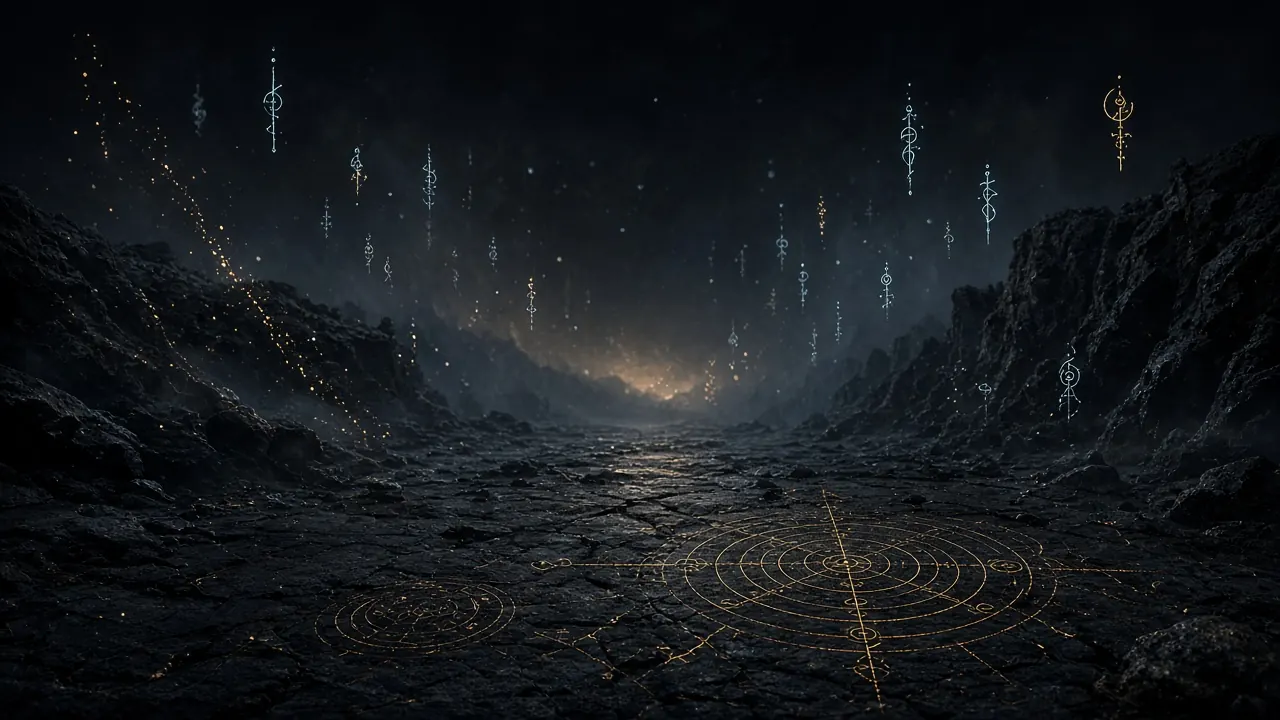
Illyria is a living world — crystal light in the stone, magnetic storms that rewrite the roads, ruins that still hum when you walk barefoot.
Veins thread the bedrock like quiet rivers of light. Night sits high and honest above the galactic plane. Human camps cling to plateaus, basins, and peat country. Older systems remain underfoot: reactors, symbols, and machines left when a civilization fled a dying sun and never fully came home to what it left behind.
You learn the stone early. Golden-cyan veins that pulse in rhythm feel curious — almost welcoming. Matte red-black veins feel wrong. Trust your soles before your map. Where the rock goes dark, people who have lived with it longer speak softly, and leave some names for later.
Places you may reach
New Haven
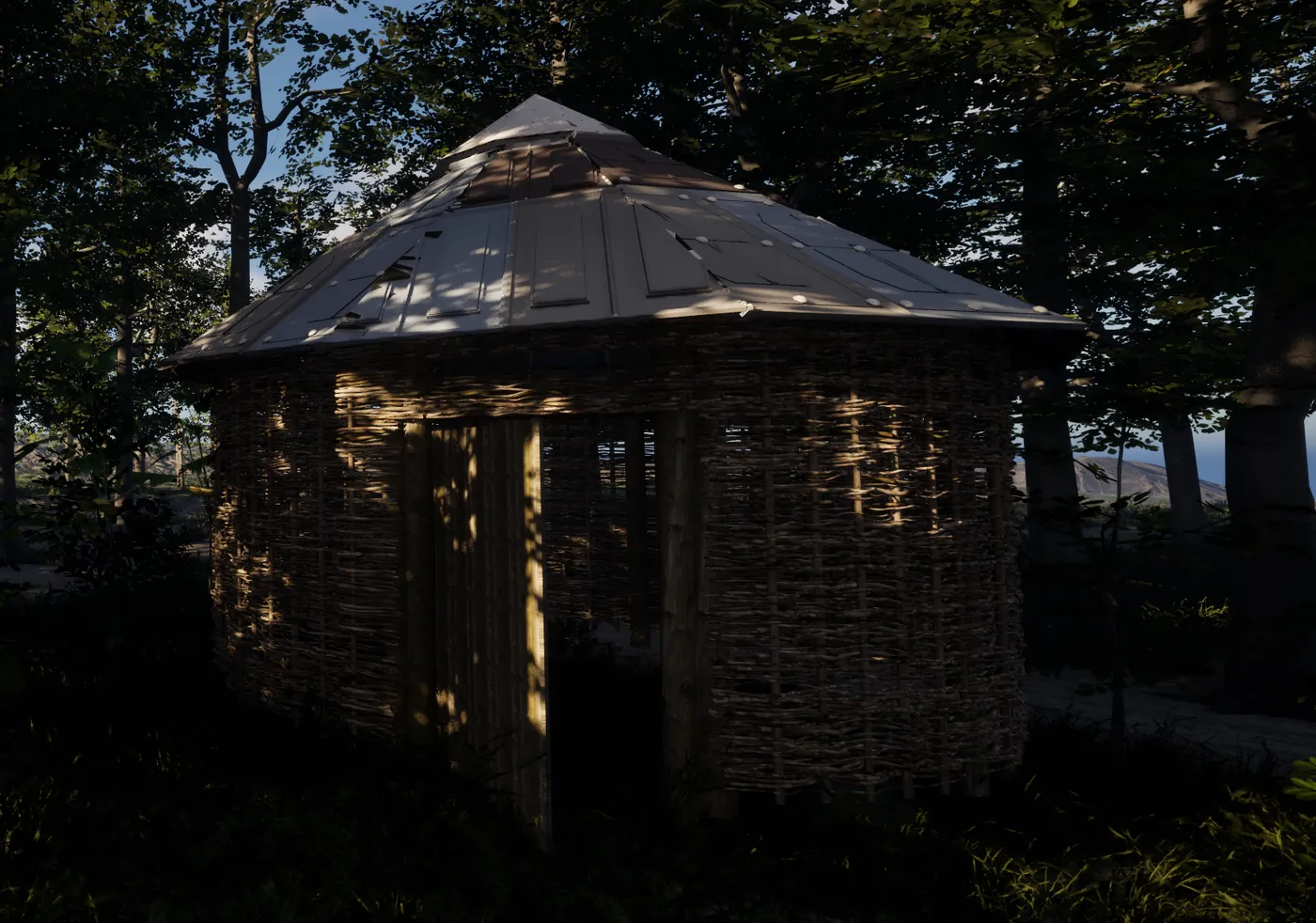
Sovereign’s crash camp becoming a town. A kitchen tarp. The ship lying like a corpse on the hillside. Hut roofs made from salvaged room partitions off the wreck, against rain-cool nights. Colonists first know Jimmy as the man who spent the trip in a tank. Marta’s kitchen is the cozy heartbeat. Commander Torres holds the line.
Aisling
Aisling did not settle so much as sink. After a rough landing the ship settled into the bog, and the people recovered little of what they had brought from Earth. Advanced-tech colonists were thrown back toward stone-age realities overnight — and the bushcraft videos somebody used to watch for fun suddenly mattered more than any schematic still buried in the mud.
What grew from that is a barter village with peat-fire hospitality and teeth. Home of the Lantern & Lilt, where Wilda O’Kelly sizes regenerated bodies before she offers stew. Warmth is real here. So is the ledger.
Serenity
A Japanese Consortium city on a high plateau beside a crater lake. The colony ship Serenity was inspired by whales — long flowing hull, sloping bow, bridge decks like a brow, wing-pods curving back like a flattened tail — and the people kept that hull intact on the plateau. Visitors walk up a ramp into her. Jimmy’s first reaction is the honest one: “It looks like a whale!”
The city grown around her is not whale-shaped. Streets, districts, tea houses, industry spilling into the valleys — if anything, Serenity could be confused for an Earth city, except for the magnetic storms dancing in the atmosphere and the pulsing crystal veins you catch here and there in the stone. Clean landing. Grace and competence. Quieter questions underfoot. Roughly a hundred and fifty thousand people call it home.
Lada
Lada landed soft — soft enough that people started cutting the ship apart to build homes on the surface — and then the weather turned. Storms stopped feeling like weather. Radiation punched through hull plate. Colonists got sick. Between the worst of it they scraped rooms into the bedrock, hauled stone, and buried what was left of the ship under a filled valley, because open ground felt hunted.
Forty years on they are still an underground people: footpaths and timber work above, fitted-stone trenches roofed with ship plate, lantern-lit staging halls, and cavern quarters under a colony hull that has been slowly losing a fight with the void beneath it. Remote. Storm-sieged. Stubborn. When outsiders finally find them, the first impression is not a town on a map — it is a hole in the earth that refused to die.
Elysara
Elysara is where the people of the Intrepid put down roots — an older human thread on Illyria, not a fresh crash-camp from the later colony wave.
They did not start with a clean landing pad and a kitchen tarp. Early survivors sheltered in ancient Illyrian spaces, then grew a city that is still half inheritance and half invention: living in an Illyrian city and building human work into it, around it, and through it. Stone that remembers older hands. Streets and screens that feel almost Earth-normal. A metropolis polished enough to broadcast news across the colony web — and old enough that its foundations were never only human.
They are also cut off. A defensive barrier wrapped their region long ago — meant for someone else’s war — and the wall still holds. Elysara can look finished on the inside while the rest of the human web only reaches it the hard way, if at all. Grit camps and buried ships on one side of the map; a hybrid city sealed away on the other.
Tengri
Tengri did not just land hard — it crashed, badly. What remained of the people had to survive in basin ruins while cyberbugs set upon them again and again. They lived by ingenuity: listening to the planet, adapting faster than the next attack, carrying folk song, elders, and percussion through nights that could have ended them.
They stopped living on the crash floor. Platforms and walkways went up into the trees — salvage lashed to living trunks — so cyberbug rushes hit empty ground more often than sleeping families. Song and elders still gather around fire; the fire just burns higher than the things that hunt them.
A celebration fire here can make a crash-camp feel like a people for the first time. Older knowledge of the wrongness in the veins is spoken carefully — earned, not borrowed.
Other human stories stretch across Illyria’s sky. The ones you meet first are grit, bog barter, plateau polish, buried stubbornness, a sealed hybrid city, and song in the trees — earned one place at a time.